русский
 Français
 한국어
한국어 عربى
عربى Español
 中文简体
中文简体How to choose a good steam iron?
Admin 2026-05-22Content
- 1 Wattage: The Foundation of Ironing Performance
- 2 Steam Output: Continuous Steam Rate and Steam Shot Performance
- 3 Sole Plate Material: The Surface That Actually Touches Your Clothes
- 4 Water Tank Capacity and Refilling Convenience
- 5 Temperature Settings and Fabric Compatibility
- 6 Weight, Shape, and Ergonomics: Comfort Over a Full Ironing Session
- 7 Safety Features: Auto Shut-Off and Tip-Over Protection
- 8 Anti-Scale and Self-Cleaning Systems
- 9 Corded vs. Cordless Steam Irons
- 10 Steam Iron vs. Steam Station: Which Is Right for You?
- 11 Price Tiers: What You Actually Get at Each Level
- 12 Final Checklist: What to Confirm Before Buying a Steam Iron
A good steam iron is defined by five core factors: wattage (2,400 W or higher for home use), steam output (at least 40 g/min continuous steam), sole plate material, water tank capacity, and the range of steam settings it offers. If a steam iron scores well on all five, it will handle every fabric type efficiently, from lightweight silk to thick denim, without damaging clothes or wasting time on repeated passes. Beyond those fundamentals, weight, cord length, auto shut-off, anti-scale systems, and price tier determine whether a particular model fits your ironing habits and budget.
The sections below explain each factor in detail — with specific numbers and comparisons — so you can evaluate any steam iron before buying it and avoid the most common purchasing mistakes.
Wattage: The Foundation of Ironing Performance
Wattage determines how quickly the iron heats up, how well it maintains temperature under continuous use, and how much steam it can generate. It is the single most important specification to check first.
Minimum Wattage Recommendations by Use Case
Consumer steam irons range from around 1,400 W on the low end to 3,200 W on the high end. The practical implications are significant:
- Below 2,000 W: Adequate only for light, infrequent ironing of thin fabrics. Temperature recovery after steam bursts is slow, making ironing heavy cotton or linen frustrating and time-consuming.
- 2,000 W to 2,400 W: The entry point for a genuinely capable home iron. Handles mixed fabric loads reasonably well but may slow down during prolonged sessions.
- 2,400 W to 2,800 W: The optimal range for most households. Heats up in under 30 seconds, maintains temperature consistently across all fabric types, and produces sufficient steam for thick materials.
- 2,800 W to 3,200 W: Professional-level output. Best for large ironing loads, heavy fabrics such as denim and linen, or those who iron multiple times per week.
A higher-wattage iron is not always better in absolute terms — it also draws more power — but for most households ironing a mixed load of shirts, trousers, and bedding, 2,400 W is the recommended minimum. An iron with 2,600 W and a good thermostat will outperform a 3,000 W iron with a mediocre heating element every time.
Heat-Up Time: What Wattage Means in Practice
A 2,400 W iron typically reaches ironing temperature in 20 to 30 seconds. A 1,600 W model may take 60 to 90 seconds. Over a year of daily use, that difference adds up to more than four hours of waiting for the iron to be ready — a clear argument for investing in adequate wattage from the start.
Steam Output: Continuous Steam Rate and Steam Shot Performance
Steam output is measured in two ways: continuous steam rate (grams per minute during regular ironing) and steam shot or boost (a concentrated burst of steam on demand). Both matter, and understanding the difference helps set realistic expectations.
Continuous Steam Rate
The continuous steam rate tells you how much moisture the iron delivers during normal gliding use. A good steam iron for home use should deliver at least 40 g/min; high-end models reach 60 to 80 g/min. For context, a cotton dress shirt benefits noticeably from 50+ g/min because the steam penetrates the fibers more deeply, relaxing wrinkles with fewer passes. Low steam output (below 30 g/min) means you end up pressing harder or making more passes, which can stretch fabric over time.
Steam station irons (separate boiler units) take this further, delivering 100 to 150+ g/min with essentially unlimited steam, which is why they are preferred for large ironing loads. However, they cost significantly more and take up more counter space than a standard steam iron.
Steam Shot (Steam Boost)
The steam shot function delivers a concentrated burst of steam — typically 100 to 250 g per burst — on demand, activated by pressing a button. This is particularly useful for stubborn collar creases, heavy denim seams, and vertical steaming of garments on hangers. Look for an iron that delivers a steam shot of at least 150 g per burst and allows you to use it repeatedly within 5 to 10 seconds without the steam dropping off significantly, which would indicate the iron's boiler cannot replenish fast enough.
Drip-Free and Dry Ironing Modes
At low temperatures required for delicate fabrics (silk, synthetics), the sole plate does not stay hot enough to vaporize water completely, leading to water dripping onto the fabric and causing water spots. A good steam iron should have a drip-free or dry ironing mode that disables steam automatically when the temperature is set below the safe threshold — typically below 120°C. Check that this feature is specifically mentioned in the product specification, as irons without it are genuinely problematic for delicate fabric care.
Sole Plate Material: The Surface That Actually Touches Your Clothes
The sole plate is the ironing surface, and its material determines glide performance, scratch resistance, heat distribution uniformity, and how well the iron works across different fabrics. This is an area where cheap irons consistently disappoint and where a better material genuinely justifies a higher price.
Stainless Steel
Stainless steel sole plates are the most common and offer good durability, reasonable glide, and ease of cleaning. They distribute heat fairly evenly and resist scratching better than coated aluminum. The main drawback is that uncoated stainless steel does not glide as effortlessly as treated alternatives — it can feel like slight friction resistance on cotton and linen. However, a stainless plate with a high-quality polish or micro-finish significantly reduces this issue. Stainless is a dependable choice for everyday ironing and holds up well to accidental contact with zips and buttons.
Non-Stick Coated Sole Plates
Non-stick coatings (ceramic, titanium, or PTFE-based) applied to an aluminum or stainless base provide the easiest glide and make cleaning straightforward — synthetic residue and starch buildup wipe off with a damp cloth. Ceramic coatings are currently the most popular choice in mid-range irons because they combine good non-stick performance with better heat resistance and scratch resistance than older PTFE coatings. The limitation of any non-stick coating is that it can be permanently damaged by dragging the iron over zips, metal fasteners, or rough surfaces, which creates scratches that catch on fabric. For households ironing fine fabrics frequently, a ceramic-coated sole plate is the best balance of glide, heat distribution, and care requirements.
Anodized Aluminum
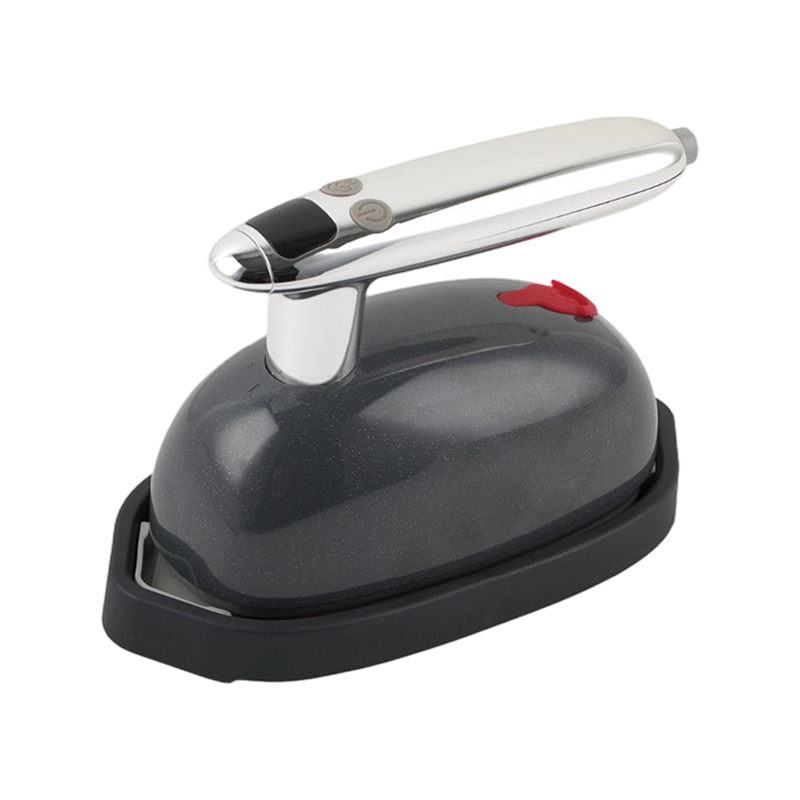
Anodized aluminum combines the excellent thermal conductivity of aluminum — which heats faster and distributes heat more uniformly than steel — with a hard oxide surface layer that improves durability and scratch resistance over bare aluminum. Some premium irons use anodized aluminum sole plates to achieve faster heat-up times and more consistent temperature across the entire sole surface, including the tip. The trade-off is that anodized aluminum is more susceptible to damage from accidental drops than stainless steel.
Sole Plate Comparison Summary
| Sole Plate Type | Glide | Heat Distribution | Scratch Resistance | Best For |
|---|---|---|---|---|
| Polished stainless steel | Good | Good | Excellent | Durable everyday use, mixed fabrics |
| Ceramic-coated | Excellent | Very good | Good | Fine fabrics, frequent ironing |
| Titanium-coated | Excellent | Very good | Very good | Heavy use, delicate + robust fabrics |
| Anodized aluminum | Very good | Excellent | Moderate | Fast heat-up, even temperature |
| PTFE (Teflon) coated | Excellent | Good | Poor | Light occasional use, budget range |
Water Tank Capacity and Refilling Convenience
The water tank determines how long you can iron before needing to stop and refill. This matters more than many buyers anticipate — interrupting an ironing session to refill a small tank is one of the most common frustrations reported with budget steam irons.
Standard steam iron tanks range from 200 ml to 400 ml. At a steam output of 40 g/min, a 200 ml tank lasts approximately 5 minutes of continuous steaming — barely enough for a shirt. A 350 ml tank provides around 8 to 9 minutes, covering two to three garments before refilling is needed. For households that iron more than four or five items in a session, a tank of at least 300 ml is strongly recommended.
Fill Opening Design
The fill opening should be wide enough to insert the spout of a small jug or cup without spilling. Narrow fill openings — a common cost-cutting measure — require using the small plastic cup often supplied with the iron, which adds time and inconvenience. Check that the fill opening is accessible while the iron is upright (handle position) rather than requiring you to lay the iron on its side, as this prevents accidental spills during refilling.
Water Type Compatibility
Most steam irons are designed for use with tap water in areas with low to moderate water hardness. In hard water areas (calcium carbonate above 200 mg/L), scale buildup inside the boiler and steam passages is a leading cause of early iron failure and spitting of brownish water onto clothes. Look for irons with a built-in anti-scale cartridge or anti-calc system — either a removable and replaceable filter or a self-cleaning function — if you live in a hard water region. Some manufacturers also state that their irons can use 100% distilled water, which eliminates scaling entirely but can cause corrosion in irons not designed for it.
Temperature Settings and Fabric Compatibility
A good steam iron must handle the full range of fabric temperatures safely and precisely. The classic three-dot temperature system (one dot for synthetics, two dots for wool/silk, three dots for cotton/linen) is the industry standard, and every iron should cover this range clearly. The critical question is how accurately and consistently the iron holds the set temperature.
Temperature Accuracy and Stability
Cheap irons with poor thermostats can overshoot the set temperature by 20 to 40°C, which is enough to scorch acetate or nylon. A quality iron should maintain the set temperature within ±10°C of the target, cycling on and off smoothly to hold this range rather than swinging widely between overheated and underheated. Unfortunately, thermostat quality is rarely published as a specification — it must be inferred from price tier and user reviews. As a general rule, irons above the USD 50–60 equivalent price point from reputable manufacturers have meaningfully better thermostats than budget alternatives.
Temperature Range by Fabric Type
| Fabric | Iron Temperature | Dot Setting | Steam Recommended |
|---|---|---|---|
| Acetate / synthetic blends | 80°C – 110°C | 1 dot | No (drip risk) |
| Nylon / polyester | 110°C – 135°C | 1 dot | No / light |
| Silk | 110°C – 140°C | 1–2 dots | No (use damp cloth) |
| Wool | 135°C – 160°C | 2 dots | Yes (with pressing cloth) |
| Cotton | 180°C – 210°C | 3 dots | Yes |
| Linen | 200°C – 230°C | 3 dots | Yes (heavy steam) |
Weight, Shape, and Ergonomics: Comfort Over a Full Ironing Session
An iron that performs well technically but causes wrist fatigue after ten minutes is not a good iron for sustained use. Ergonomics should be evaluated based on your specific ironing habits.
Weight: Light vs. Heavy Irons
Steam irons typically weigh between 1.0 kg and 1.8 kg. Heavier irons press wrinkles out with less manual pressure needed, which can reduce effort for thick fabrics. Lighter irons reduce wrist strain and are easier to maneuver, particularly for delicate items or garments with complex shapes. The right weight depends on the fabric types you iron most often: those primarily ironing heavy cotton shirts and linen will benefit from a slightly heavier iron (around 1.4–1.6 kg), while those dealing mainly with blouses, synthetics, and lightweight garments will prefer something closer to 1.1–1.3 kg.
Handle Comfort and Grip
The handle should feel balanced in your hand — not too back-heavy (which strains the wrist) or too front-heavy (which makes it difficult to control). A rubberized or soft-touch grip surface reduces hand fatigue significantly over long sessions compared to hard plastic handles. The steam trigger or button should be reachable with your index finger without repositioning your grip, and the temperature dial or control should be clearly marked and easy to adjust with one hand.
Cord Length and Swivel
The power cord should be at least 2.5 meters long — shorter cords restrict movement to a small ironing area and require the outlet to be very close to the ironing board, which is often impractical. Look for a 360° swivel cord attachment at the iron's heel — this allows the cord to rotate freely in any direction as you move the iron, preventing twisting and tangling that would otherwise interrupt the ironing rhythm and wear the cord at the connection point.
Sole Plate Tip Shape
A narrow, pointed tip makes it significantly easier to iron around buttons, into pleats, collar points, and between shirt buttons. Irons with a wider, rounder tip are less maneuverable and require more repositioning around garment details. This is a genuinely important ergonomic detail — a well-pointed tip can reduce the time spent on a dress shirt by 15 to 25% compared to a blunt-tipped equivalent.
Safety Features: Auto Shut-Off and Tip-Over Protection
Safety features are non-negotiable in a household appliance that reaches 200°C+ and is used near clothing and other combustible materials. Two features in particular should be verified before purchasing.
Auto Shut-Off
Auto shut-off automatically cuts power to the heating element when the iron has been stationary for a set period — typically 30 seconds when placed flat (sole plate down) and 8 to 10 minutes when left standing on its heel rest. This protects against fire risk from forgotten irons resting on fabric. The 30-second flat shut-off is the critical safety protection; the heel-rest timer is primarily a power-saving feature. Verify that both functions are present, not just one.
Some irons also include an indicator light or audible alert when the iron has shut off and needs to be moved or pressed before it will resume heating — a useful reminder in busy households. A good iron should restart heating within 15 to 20 seconds of being picked up and moved after an auto shut-off event, minimizing workflow disruption.
Tip-Over Protection
Tip-over protection uses an accelerometer or mechanical sensor to detect when the iron has fallen on its side and immediately cuts power. This is a critical safety feature in households with children or pets, where accidental knocking of an ironing board is a realistic risk. It is also important for any iron used at standing height where a fall directly onto fabric could ignite it. Check the product specification explicitly for this feature — it is not universal, particularly at lower price points.
Anti-Scale and Self-Cleaning Systems
Scale buildup is the leading cause of reduced steam performance and eventual failure in steam irons, particularly in hard water regions. An iron without any anti-scale provision will begin to spit discolored water and produce irregular steam within 6 to 18 months of regular use in moderate-to-hard water areas. Protecting against this extends service life significantly.
Anti-Calc Cartridges
Removable anti-calc cartridges contain an ion-exchange resin that captures calcium and magnesium ions from the water before they enter the boiler, preventing the formation of limescale deposits. These cartridges are typically replaced every 2 to 3 months depending on use frequency and water hardness. The ongoing cartridge replacement cost should be factored into the total ownership cost of the iron — check availability and price of replacement cartridges before purchasing a model that uses them.
Self-Cleaning (Calc-Clean) Function
The self-cleaning function — sometimes labeled "calc-clean," "auto-clean," or "steam clean" — works by flushing the steam passages with a burst of pressurized steam and water that dislodges and expels scale deposits. This is typically done over a sink, with the iron at maximum temperature and the steam control fully open, producing a vigorous flush of hot water and scale particles. Performing this function every 2 to 4 weeks in hard water areas maintains full steam performance and prevents the gradual blockage of steam vents that leads to spitting. Look for this feature as a dedicated button or setting rather than having to disassemble any part of the iron.
Corded vs. Cordless Steam Irons
Cordless steam irons are a relatively recent category that eliminates the cord entirely by using a charging base on the ironing board. The iron is used unplugged and returned to the base to reheat between passes.
The appeal is real: no cord to catch under the iron, no risk of ironing the cord, and complete freedom of movement. The limitations are also real: cordless irons must be returned to the base every 30 to 45 seconds to maintain ironing temperature — a rhythm that suits short, frequent pauses but can slow down the ironing of large items like bedsheets and tablecloths. Steam output in cordless models is also generally lower than corded equivalents at the same price point, because the heating element must be efficient enough to operate on stored heat rather than continuous power.
For most households ironing a variety of garment types and sizes, a corded steam iron at 2,400+ W remains the more practical and powerful choice. Cordless irons are best suited to frequent touch-up ironing of small areas — a collar here, a shirt front there — rather than systematic ironing of full laundry loads.
Steam Iron vs. Steam Station: Which Is Right for You?
A steam station (also called a pressurized steam iron or generator iron) pairs a large separate water tank and boiler unit with a lightweight iron head connected by a hose. It delivers continuous steam at significantly higher pressures and volumes than a standard steam iron.
| Feature | Standard Steam Iron | Steam Station |
|---|---|---|
| Continuous steam output | 30 – 80 g/min | 100 – 160+ g/min |
| Water tank capacity | 200 – 400 ml | 1,200 – 2,000+ ml |
| Iron head weight | 1.0 – 1.8 kg | 0.7 – 1.0 kg (head only) |
| Setup time | 30 seconds heat-up | 2 – 4 minutes to pressurize |
| Ironing speed | Standard | Up to 2× faster |
| Storage space required | Minimal | Significant (base unit) |
| Typical price range | USD 30 – 150 | USD 120 – 500+ |
| Best for | Households ironing 1–3 times per week | Daily or large-load ironing, heavy fabrics |
The steam station's significantly higher steam output cuts ironing time roughly in half for large cotton loads like shirts and bedding, and the lightweight iron head reduces arm fatigue dramatically. However, it requires storage space for the base unit, a longer setup time before ironing can begin, and a considerably higher purchase price. For most households ironing two to four loads per week, a high-quality standard steam iron at 2,400–2,800 W is the more practical, cost-effective choice. A steam station becomes genuinely worthwhile for daily ironing of large households or heavy linen loads.
Price Tiers: What You Actually Get at Each Level
Steam iron prices span a wide range, and understanding what genuinely improves at each tier helps avoid both underspending (and tolerating a frustrating iron for years) and overspending on features that don't affect daily performance.
- Under USD 30: Basic function only. Typically 1,600–2,000 W, limited steam output, basic stainless or PTFE sole plate, no anti-scale system, no auto shut-off in many cases. Suitable only for very occasional use. Expect a service life of 1 to 3 years.
- USD 30 – 60: Competent everyday iron. Usually 2,200–2,400 W, 35–50 g/min steam, ceramic or good stainless sole plate, basic auto shut-off, small tank. Good thermostat accuracy at the upper end of this range. This is the practical minimum for a household that irons regularly.
- USD 60 – 120: Significantly better performance. 2,400–2,800 W, 50–70 g/min steam, premium ceramic or titanium sole plate, reliable auto shut-off with tip-over protection, anti-calc system, larger tank (300–400 ml). Noticeably better temperature stability and ease of use. This is the sweet spot for most households.
- USD 120 – 200: High-performance standard irons. 2,800–3,200 W, 70–100 g/min steam, premium sole plate with specialized coatings, advanced anti-scale, precision thermostats, ergonomic handles, and often superior build quality. Worthwhile for those who iron frequently or handle difficult fabrics regularly.
- Above USD 200: Entry into steam station territory or specialist irons. At this price, a steam station is usually the better investment over a handheld iron for the performance delivered.
Final Checklist: What to Confirm Before Buying a Steam Iron
Use this checklist as a practical evaluation tool for any steam iron you are considering:
- Wattage: Is it 2,400 W or higher? If below this, understand the performance limitations before buying.
- Continuous steam output: Is it 40 g/min or more? Does it specify a steam shot rating of at least 150 g per burst?
- Sole plate material: Is it ceramic, titanium, or polished stainless steel? Avoid bare aluminum or PTFE-only coatings for regular use.
- Water tank: Is the capacity at least 300 ml? Is the fill opening easy to use without a dedicated cup?
- Drip-free mode: Does it automatically disable steam at low temperatures to protect delicate fabrics?
- Auto shut-off: Does it include both flat-position shut-off (within 30 seconds) and heel-rest shut-off (within 10 minutes)?
- Anti-scale provision: Does it include a removable anti-calc cartridge, a self-cleaning function, or both?
- Cord length and swivel: Is the cord at least 2.5 m long with a 360° swivel attachment?
- Weight: Does it fall in the 1.1–1.6 kg range appropriate for your primary fabric types?
- Price tier: Does it fall in the USD 60–120 range where performance-per-dollar is best for most household users?
An iron that satisfies all ten points will serve reliably for 5 to 8 years or more under regular household use — making even a USD 80–100 investment considerably more economical per year than replacing a USD 30 iron every two years while tolerating inferior performance throughout.
For exclusive deals and latest offers, sign up by entering your email address below.